


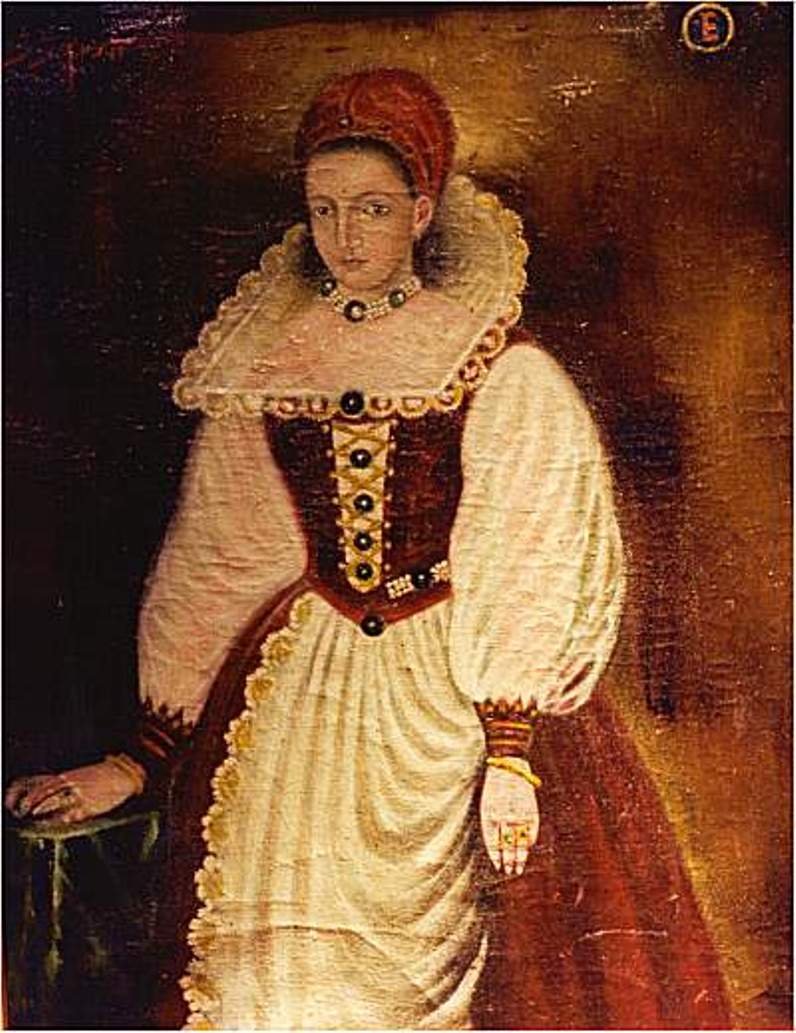
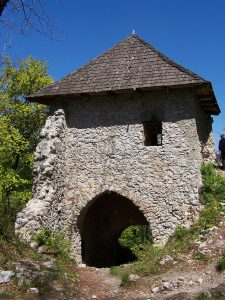
The name of Erzsébet Báthory evokes horrorfilm-like myths of the ’Bloody Countess’, but did she really bathe in the blood of virgins, or was she the victim of power games and rumours? There are still plenty of question marks surrounding the events that once played out in the fortress of Čachtice (Csejte), which today belongs to Slovakia. This article seeks to reevaluate the Countess Báthory’s life story on the basis of contemporary sources.
Erzsébet Báthory is considered to be one of the most ruthless serial murderers of all time: according to an unknown witness name only by her first name as Zsuzsanna, the Countess killed 650 young girls. The investigation started at around 1610 probabyl gave rise to countless rumours, but the story of the ruthless aristocratic lady as it is known today only emerged as a coherent legend in the 18th century. Jesuit monk László Thuróczy compiled a description of the Kingdom of Hungary as it was at the time. His work, published in 1729 is a typical example of 18th century country descriptions. It is in his book Ungaria suis cum regibus compendio data or A Brief Introduction to Hungary and Her Kings that we can read the story that made Erzsébet Báthory world famous. Allegedly, when combing her hair, her maidservant accidentally pulled her hair and the countess was so enraged that she slapped the servant mightily. The servant’s nose started to bleed heavily, splattering her mistress, who was surprised to see that her skin where it had come into contact with the blood became young and immaculate. It was after this incident that she took up the habit of ’bathing’ in the blood of young girls in the hope of attaining eternal youth and immortality. However, Thuróczi makes it obvious that the story he wrote down is an educational parable, depicting the countess who abandoned the true Catholic faith and thus fell prey to the schemes of the devil.
Who was Erzsébet Báthory?

Erzsébet Báthory of Ecsed was born in 1560. Her parents were György Báthory of Ecsed and Anna Báthory of Somlyó, who were not closely related despite their identical surnames: the two branches of the Báthory family had separated some one and a half centuries earlier. Erzsébet was married off at the age of 15, as part of a family agreement, as was the custom of the time, to Ferenc Nádasdy, son of palatine Tamás Nádasdy and Orsolya Kanizsai. Their wedding took place in 1575, by which time none of their parents were alive. Ferenc Nádasdy was 20 at the time, so they were roughly the same age. We know very little about the everyday life of their married years. While Tamás Nádasdy and Orsolya Kanizsai had been in constant correspondence in their time and their letters are among the most valuable historical sources on daily life in 16th century Hungary, Erzsébet and Ferenc left but a handful of surviving letters. These fragments, however, testify to a loving and caring family. In a letter by Ferenc Nádasdy to Miklós Pálffy he says he can’t meet Pálffy because he must hurry back home to his wife. The couple had 5 children, Anna, Kata, Orsolya, András and Pál, only three of whom lived to see adulthood.

Ferenc Nádasdy died in 1604. The specific reasons are unknown, the sources just say that he was already ill when he arrived home in late 1603. His widow held together the family now left without a head with great discipline. She managed their estate sensibly. In a letter she wrote to her supporter, Ferenc Batthyány, she says she is thankful for his advice suggesting she sell her grain to the army but it will fetch more if sold on the market. In 1608 she carried out a comprehensive survey (as we would call it today) of her estate, including a census of the population of her villages and listing her income. Maybe this led to her downfall.
In early 1610 palatine György Thurzó cited ’rumours’ as the basis of an investigation that he initiated in the villages on the Nádasdy estate concerning the alleged murder of maidservants and other young girls. Erzsébet herself was not notified about the investigation, the news presumably only reached her as a set of rumours. However, according to sources, this had no bearing on her lifestyle. She spent the summer harvest period in Sárvár as usual, and in the early autumn she set off for her estate around Csejte. In October she made a stop in Pöstyén, one of the most popular spas of the period, to enjoy the medicinal thermal water. After this she arrived in Csejte, but on the way there she even had the time and energy for the procedure declaring her son Pál’s coming of age. Nothing foreshadowed the tragedy.
Interrogations and testimonies
However, the interrogations continued – interestingly, the inhabitants of Vágújhely and Csejte were heard in the spring, when Báthory was already in Sárvár, while the peasants and farm hands in and around Sárvár were questioned in the autumn, when she was already on her way to Csejte.
In total, they collected testimonies from 327 witnesses. Research and literature on the story of Erzsébet Báthory had considered this number alone to prove the case against her – it was after a long time that somebody actually looked at the content of the witnesses’ accounts. Out of the 327 only as few as 107 witnesses gave assessable testimonies, only they had heard anything about the rumours concerning the murders. 220 witnesses hadn’t seen or heard anything relevant. 43 of the 107 proper testimonies didn’t substantiate the accusation, so they would have to be considered exculpatory witnesses. 64 people claimed to have heard anything at all concerning the case, but there was not one single eyewitness: 64 people spoke about murders, but when it came to specifics, their claims ranged from ’innumerable ruthless acts’ to 650 victims. Another important outcome of the analysis of the witnesses’ testimonies is the discovery that all substantial claims go back to the testimonies of as few as 10 people. These witnesses made the following claims: 1. A certain Zsuzsanna, whose last name and profession is unknown, mentions 650 victims. 2. Boldizsár Poky, a tipstaff from Sárvár had heard of 300 murdered girls. 3. Mihály Blahó from Kosztolkány also mentioned 300 victims. 4. János Kadludecz, also from Kosztolkány had heard about 560 victims. 5. István Racziczénusz, a vicar from Vágújhely mentioned 200 murder victims. 6. Ferenc Török had heard about 200. 7. Benedek Bicsérdy, a tipstaff from Sárvár had heard about 175 victims. 7. Anna Szelestey couldn’t give a specific number.
Benedek Dezső, steward, and Jakab Szilvásy claimed they had seen ’a host of wicked things’. These two men, who used to be Ferenc Nádasdy’s servants, were the source of all the testimonies against Erzsébet Bárhory – as we would say today, they were behind the character assassination attempt seeking to get her out of the picture.

The soldiers of palatine Thurzó surprised Erzsébet Báthory in her manor in Csejte on 29 December 1610. She was immediately taken to the fortress towering above the manor, while four people from her immediate entourage were arrested, taken to the palatine’s court in Biccse and subjected to torture. They admitted to having committed to the most horrible things, maybe even things that were in fact done to them by their torturers. In the reports we find accounts of stabbing with needles, burning with hot iron and tying up as well as damage to reproductive organs and confiscating all the victim’s clothes. These servants, simply labelled accomplices in the reports, were sentenced to death and burned at the stake. One of them, János Újvári, was first beheaded and then burned, while another accused, Kata Beniczky, at one point simply vanishes from the records, so we don’t know whether she was also sentenced to death.
One strange component of the story is that when Erzsébet Báthory was arrested, the soldiers allegedly freed one of her tortured victims, a young girl – however, she is the only one of the numerous witnesses heard in the case, who gave no testimony. She was a potential star witness – yet nobody thought to ask her what she had gone through?
Erzsébet Báthory herself never gave a testimony, while even the vicar János Ponikénusz tried to persuade her. There is a document prepared later from the investigation records, maybe in preparation for the court procedure ahead, but it never got to be used. There was no court procedure. Erzsébet Báthory was locked up in her fortress in Csejte until her death in 1614. As we know from some of his letters dated from Csejte, her son, Pál Nádasdy was allowed to visit her and spend time with her, and later he took his wife, Judit Révay to stay there with him too. This is where their son, Ferenc, the later judge royal of Hungary was born.
Lessons learnt

Many people have tried to explain this bizarre and in many details horrifying case. Potential explanations include political scheming, selfish individual gain, the power-hunger of aristocratic families and of course the unaccountable, unpredictable human soul. Most authors contend with casting Erzsébet Báthory as a mentally ill, sexually deviant predator. On reflection, individual financial gain seems to be a better candidate for the motive, though. When Erzsébet Báthory ordered a comprehensive survey of her estates, including a revision of the work of those responsible for running their operation, some of the intendants and stewards must have lost sleep over what might come to light. Benedek Dezső, steward, and Jakab Szilvásy might have felt especially threatened. Maybe it was the defamation campaign started by the two of them that started the rumours that grew into such a scandal that the palatine had no choice but to start an investigation. By the end of this, however, it became obvious, that in view of the testimonies the case against Erzsébet Báthory would not hold water in court, so the whole case was put to sleep. By executing some alleged accomplices, the authority of the palatine was saved, the image of a functioning jurisdiction was upheld.
Erzsébet Báthory did indeed become immortal, but not as a result of bathing in blood. It was the stories surrounding her that got a life of their own, creating the legend of the ’Bloody Countess’ in pursuit of eternal youth. The legend is immortal, and the very much mortal Erzsébet sleeps her eternal sleep buried in an unknown location.
Common past: knowledge to dispel historical misconceptions – supporting the work of Slovak and Hungarian history teachers through print and online publications, professional conferences. A project of the Association of History Teachers and the Hungarian-language newspaper of the Denník N news portal.
Funded by the European Union. The information and statements contained herein are those of the author(s) and do not necessarily reflect the official views of the European Union or the Tempus Public Foundation. Neither the European Union nor the funding authority can be held responsible for them.


